The text editor has a rich history, starting arguably with the first letters etched on stone in ancient times. Yet writing and taking notes has always remained a sort of “game,” arguably the oldest game in human history. What was the Epic of Gilgamesh if not an early form of interactive entertainment? Since the first GUI, computers have allowed text input in some form; it is a natural progression to expect people to use a new medium. Today people write full novels on cell phones. Society continues to play this hardest of games which, arguably, few have won.
One of the greatest and most overlooked games in this genre is Notepad, which came bundled with copies of Windows 3.1. Although it didn’t have the popularity of SkiFree or Chip’s Challenge, Notepad is a pioneering game that suggests a blank canvas, one onto which the player can project their own emergent story. It sets the tradition for the best sandbox games, from Grand Theft Auto to Skyrim. Read more »

Bouncer exists somewhere in a space between Breakout and billiards. It invokes some of the skill and strategy of pool, in part because of a more complex control scheme. But that same control scheme is less intuitive than it should be.
The goal of Bouncer is to knock similar balls together. If you don’t eliminate all the matching pairs by the end of the round’s timer, you lose. You control a Pong-style paddle with the mouse; you can push the balls around when the mouse button is held. Since aiming with a paddle is often difficult, Bouncer is capable of recognizing spin. A well-aimed shot can curve a ball’s trajectory, getting it closer to the target.

Ka-thunk!
There are a few immediate downsides. Since you’re controlling a paddle, it is often difficult to make a vertical shot (especially when there’s no room). Even when you can, the game often misinterprets finicky maneuvering as an extreme curve. Often, balls that are meant to go up — and sometimes ones meant to go horizontally — will just spin in a circle or go in a wild direction. You could feasibly make better shots with a deeper understanding of the curve system, but it’s difficult to predict. Randomly knocking things around usually yields comparable results, especially for difficult-to-hit balls on the top of the board. Unfortunately, that takes enough time to end the game.
Bouncer has low enough ambitions that it isn’t a bad game. It’s a short time-waster, and it has a large problem. But that’s alright for the one or two times you’ll play it.

Nothing can prepare you for how terrible Angst: Rahz’s Revenge is. Every second of this game is the worst. It is impossibly bad.
There are a lot of awful games out there, but Angst deserves special condemnation among first-person shooters. Its minimalist approach treats the core precepts of the shooter with contempt, exposing them as inherently flawed and harming the entire genre in the process. Read more »

Games have a dubious track record as instructional aids. I don’t mean edutainment games but rather games designed to give people virtual hands-on experiences. As the legend goes, the Sim series veterans at Maxis once built SimRefinery as an orientation tool for Chevron administrative staff who weren’t familiar with how the company worked. Adventure game luminary Sierra even at one point claimed that police officers had used Police Quest as part of their training. To my knowledge, no one has studied to see if this type of hands-on game is effective. My worry would be that someone would consider the gameplay in Police Quest a substitute for learning the real thing.
Consider those fears heightened for Life & Death, a surgical simulator that has an unclear relationship with science. The game’s manual clearly states that the game should “UNDER NO CIRCUMSTANCES” be mistaken for genuine medical advice or education, but that’s a forgivable error. Life & Death is sickeningly realistic and unfair, just like the real thing. Read more »
To anyone who may be attending and reading this on short notice: I’ll be at MAGFest in National Harbor, MD this Saturday. If anyone wants to talk old games and troll the classic game merchants for rare finds, I’d be more than glad! Just let me know in advance.

Game genres tend to be hard to separate, with the blurry lines between categories often not worth arguing. Is Mass Effect an RPG or a shooter? Does it matter? Genre terms probably find the most use as ways to discuss structure since, generally, we recognize what we’re getting into when we’re told that we’re going to play an adventure game or a fighting game. Even then, the chances of taking elements from multiple columns is high enough to render the exercise pointless.
Case in point: Crystal Caves, one of Apogee Software’s last games before they found massive success with Duke Nukem. Crystal Caves is the sort of extra-difficult platformer that begs you to repeat stages dozens of times before you complete them, god forbid with the highest possible score. It has a unique pace that encourages forethought over action. It shares more DNA with Chip’s Challenge than Mario. Read more »

The Mille Miglia was an epic automotive endurance contest that started in the late 1920s. Back before safety issues were a big deal in the racing world, the Mille Miglia sent the most foolhardy drivers on thousand-mile open road race through the Italian countryside. It popped up around the same time as similar events like the Le Mans 24-hour race, but it was canceled when officials realized that the Mille Miglia was incredibly, incredibly dangerous.
Discontinued or not, the Mille Miglia has apparently ascended to the stuff of legends — at least enough to warrant a lavish game adaptation. 1000 Miglia treats the event with an intimate reverence, celebrating the Miglia’s first decade with an eye for historical accuracy. It is, in a sense, a documentary. Despite its good intentions and semi-educational purposes, 1000 Miglia just doesn’t have the technical strength to condense such a big race to a playable scale. Read more »
It’s been a long and winding road for The Obscuritory. I’ve already covered that I had to reboot the blog several times before I found a format that worked for me, but if there was one constant through that, it’s that the blog has been hosted on Holenet.info.
As a result of some recent reconfiguration over there, The Obscuritory has left the roost and found new lodging at Obscuritory.com. This is an enormous step forward and a commitment to myself and the blog. I feel like I’ve just purchased a piece of property for the first time.
Looking forward to where the next leg of this weird journey leads.

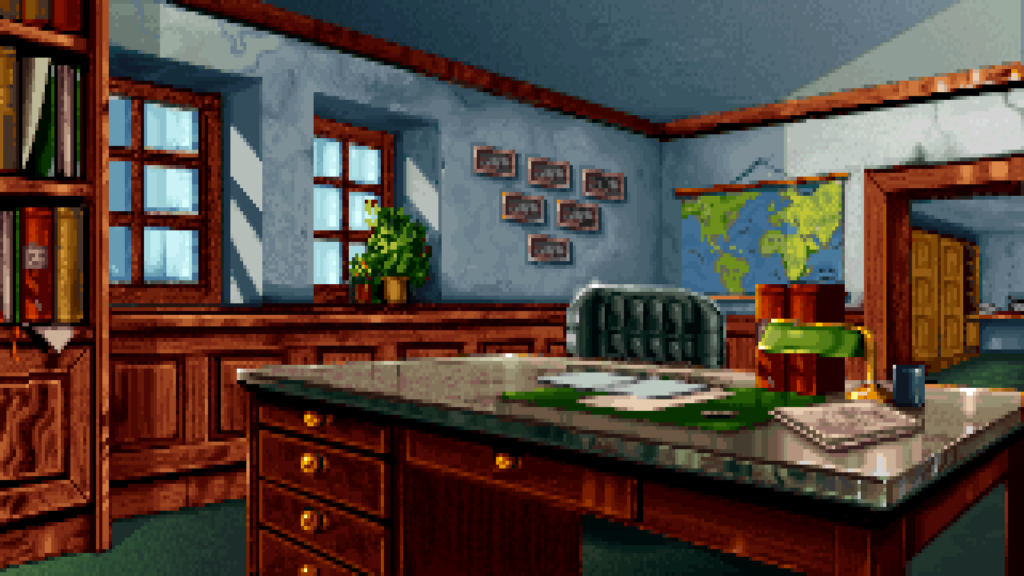
Noctropolis is a big, beautiful mess of a game. The creators at Flashpoint Productions made a massive epic set in an original comic book world, and it totally sucks. It’s a tremendous mismatch of talent and ambition, and I love it.
The soundtrack is one of the only parts of Noctropolis that keeps pace with its grand vision. The composer, Ron Saltmarsh, intended the music to play on a Roland MT-32 synthesizer rather than the standard, chintzy DOS MIDI output. Few computers at the time support that hardware, and even fewer do today. Either way, the title track, “Darksheer Theme,” will knock your boots off. Read more »

According to the “Hello World” post that WordPress made, I started The Obscuritory four years ago today!
I started this blog on a lark because of my increasing interest in CD-ROM games at the time, and I honestly just expected it’d fizzle out after I lost interest. And it did, at least twice. I rebooted this blog several times before I finally figured out a style that worked for me and that people enjoyed reading, and it was worth putting in the effort.
I’ll be the first to acknowledge how sporadic the updates are, but having The Obscuritory as outlet for me to talk about old, forgotten games has been exciting and liberating. I really did not think I would follow through on it, but here we are. Thanks for reading if you have!
Posted on April 1st, 2013 by Shadsy
1 Comment »